Review · Drama
Adieu Eri
A middle-schooler films his mother's slow death, botches the film, then meets a girl who teaches him to shoot all over again. From the author of Chainsaw Man, a one-shot that makes cinema with a pocket camera. We read it, and read it again: here is our review.
Review published on .
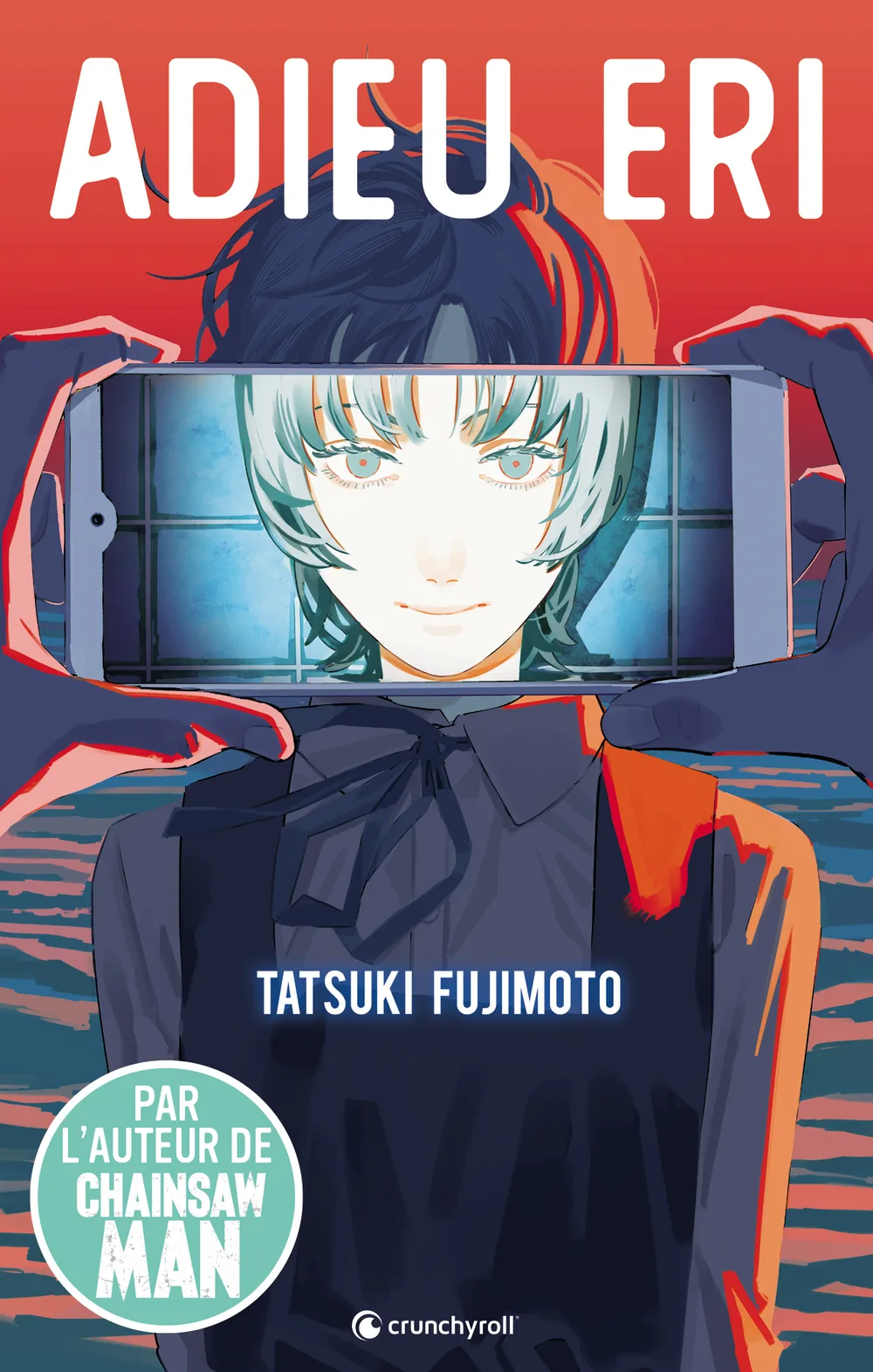
Adieu Eri (Sayonara Eri) © Tatsuki Fujimoto / SHUEISHA Inc. 2022. French edition Crunchyroll. Reproduction subject to permission.
For his twelfth birthday, Yûta is given a smartphone and an instruction from his mother: film her until the end. She is dying. From that poisoned gift he cuts a film — a failure, mocked — then climbs onto a rooftop to end it all. That's where Eri stops him. Tatsuki Fujimoto starts from this tiny grief to ask his favourite question: what good is it to film the people we lose?
Adieu Eri (Sayonara Eri) is a one-shot by Tatsuki Fujimoto, the author of Chainsaw Man and Look Back. Serialised on Shōnen Jump+ in April 2022, it was published in France by Crunchyroll on 18 January 2023: 208 pages in black and white, in the vein of those short, dense stories Fujimoto slips in between two sprawling series.
The pitch unfolds in two acts. As a child, Yûta films his dying mother and edits it into a montage, Dead Explosion Mother, which ends with the hospital blowing up rather than with her actual death. Humiliated by the school screening, he gives up on cinema — until Eri, a mysterious cinephile, draws him into a makeshift screening room and rekindles his urge to shoot. Together, they decide to make a film about her.
It's hard to say much more without spoiling a story built entirely on its reversals. Suffice it to say that, true to his motto — "a little bit of the fantastical" — Fujimoto lets reality slip in his final pages, and Yûta's grief ends up replaying one time too many.
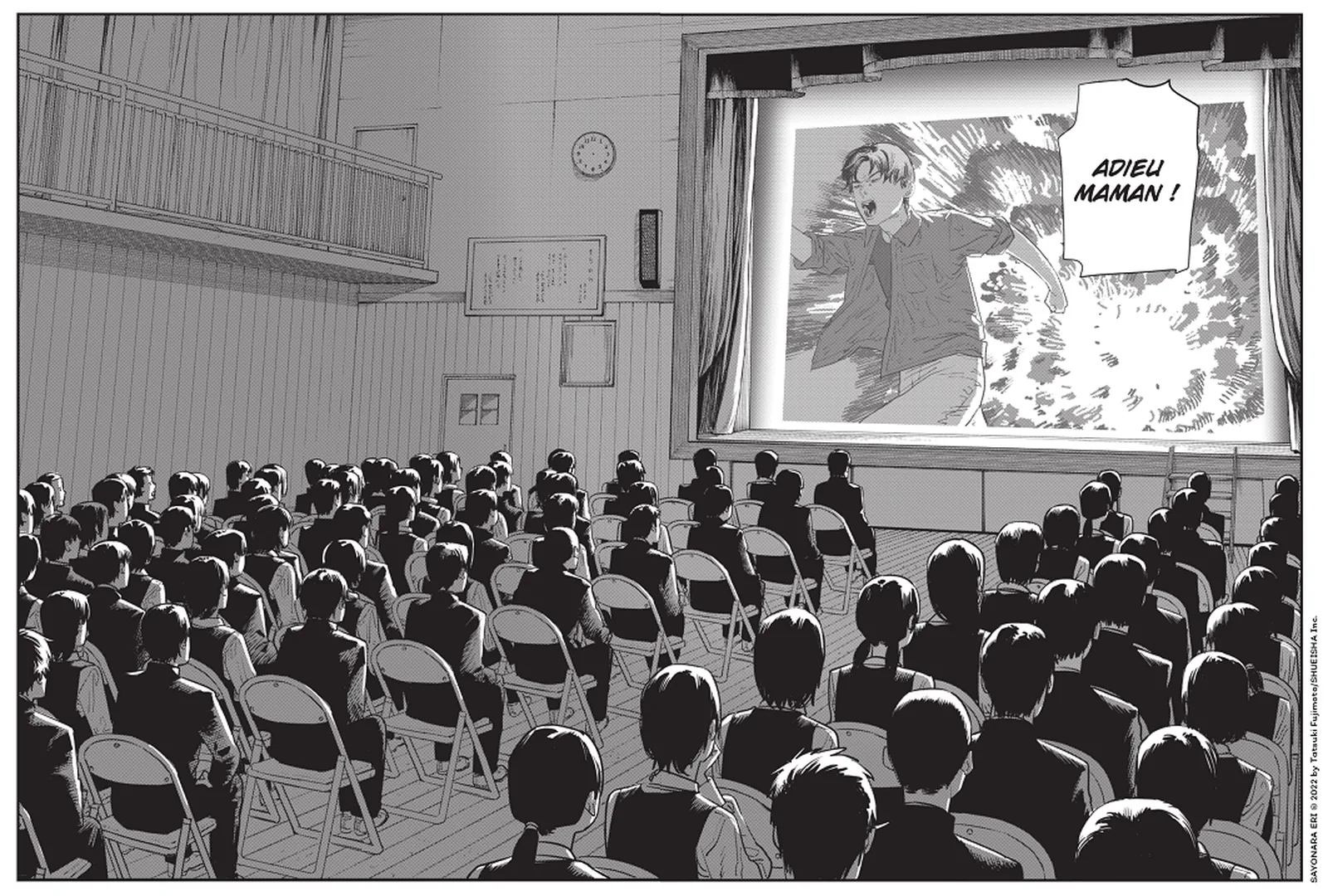
"I just wanted to keep a little life in her."Adieu Eri — the stakes, in one line
The real subject of Adieu Eri isn't death: it's editing. What do we keep, what do we erase, which shot do we choose to remember someone by? Fujimoto turns this cinephile's question into a mechanics of grief, and pulls off the feat of fitting it all into a pocket format.
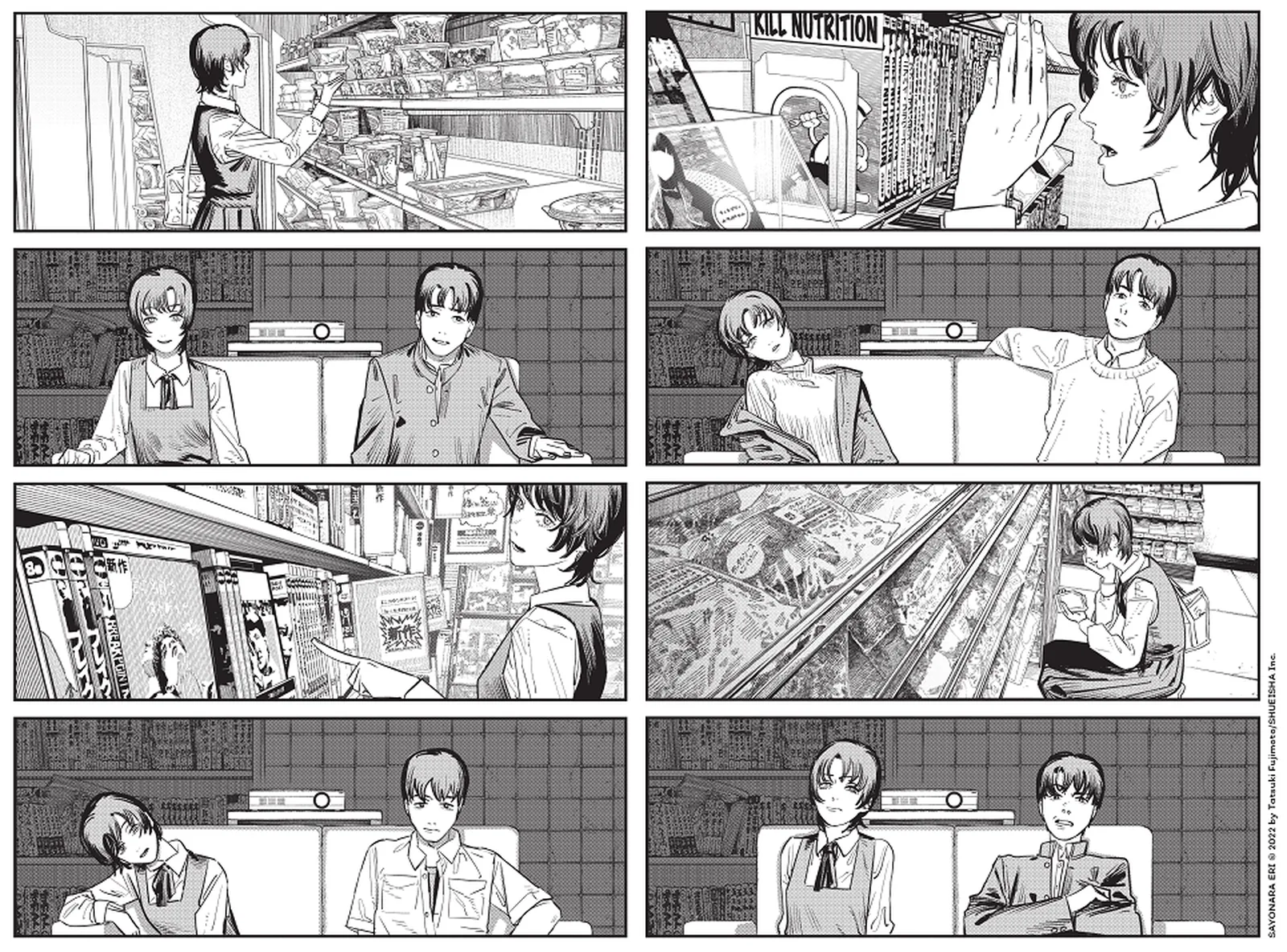
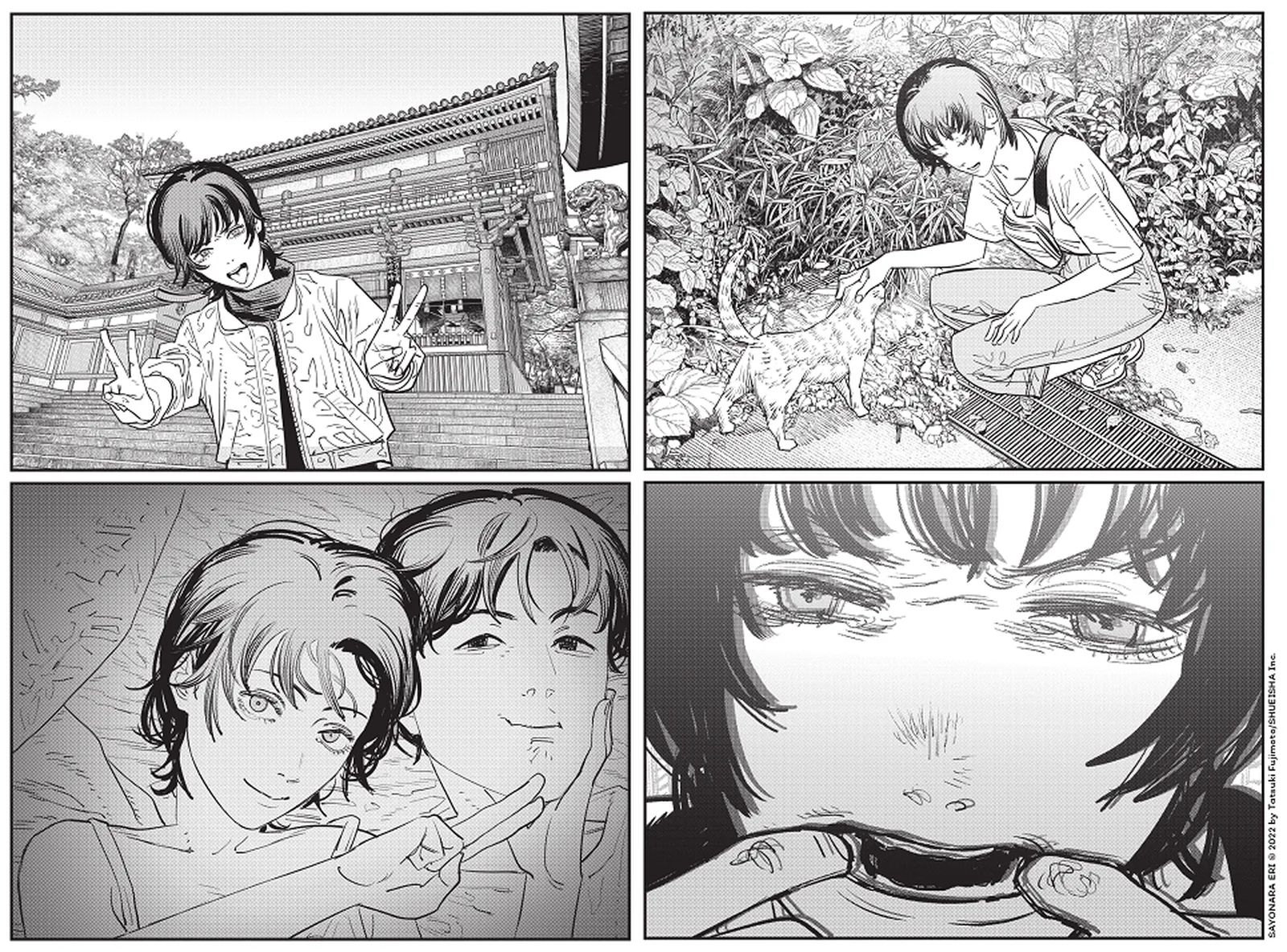
The masterstroke is the form. Almost the entire volume is cut into rectangular panels of the same size, in a cinemascope ratio, like so many images filmed at shoulder height. You find the motion blur, the shots that linger, the crooked framing of a handheld camera. The fully black pages act as cuts. Fujimoto isn't telling a story about cinema: he shoots a film in manga, and puts us in the place of the one holding the camera.
That choice pays off on every re-read. The repeated panels, disorienting at first, become rhythm; the tonal shifts — teen comedy, melodrama, the fantastical — slot together like sequences. And the point surfaces without ever being hammered home: we film the dead to make them beautiful, to correct reality, to keep watching them move. Dead Explosion Mother ends with an explosion precisely because Yûta can't bear to film the truth.
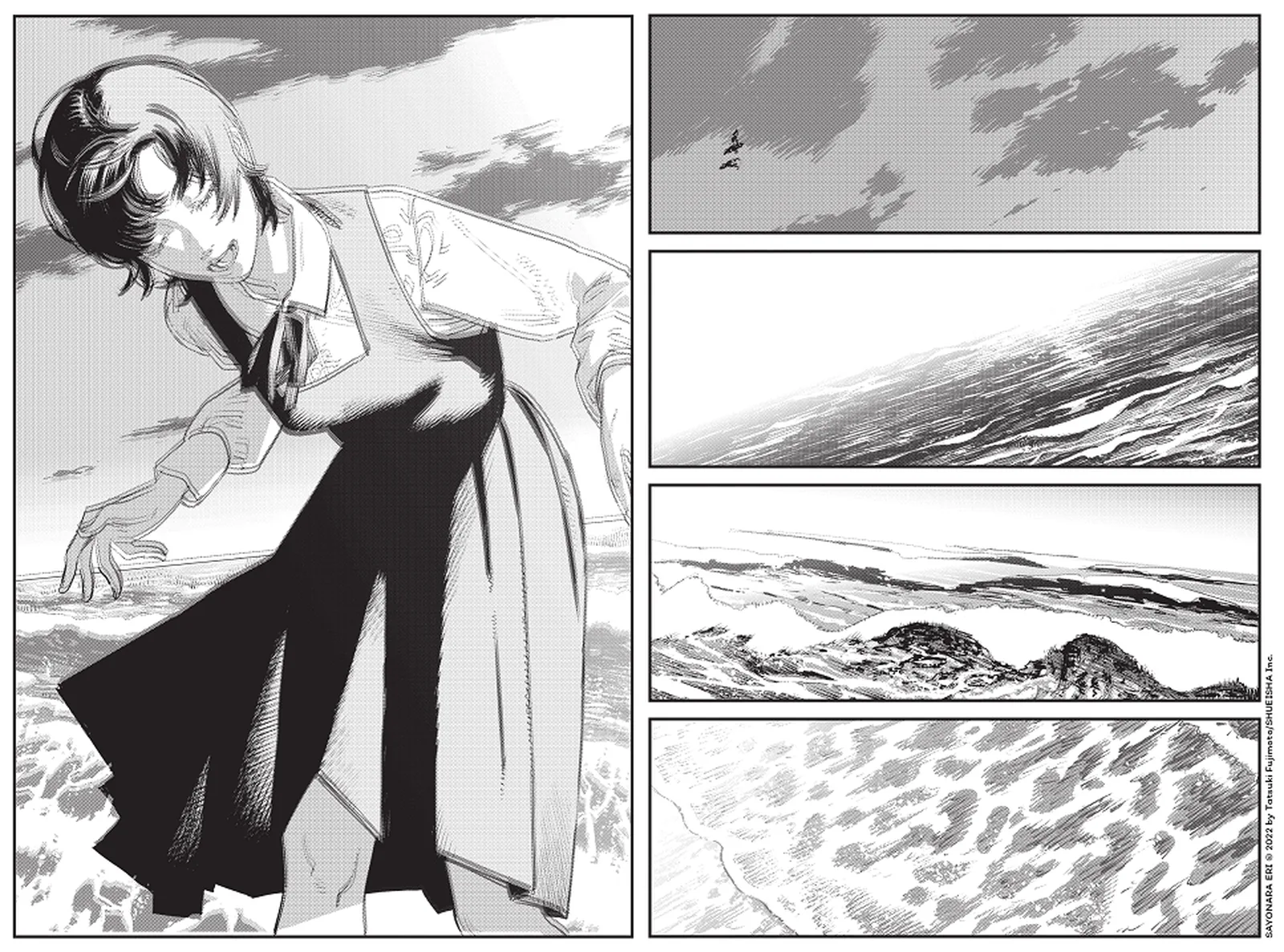
Then comes the final movement. True to himself, Fujimoto allows a fantastical turn that will divide readers: some will read it as the most beautiful statement there is on fiction as survival, others as a sleight of hand. This is where Adieu Eri asks for a little trust — and where a second reading changes everything.
Strengths
- A brilliant formal device: the manga as a camera, from the first shot to the last.
- A rare emotional charge, achieved with a disarming economy of means.
- A crystal-clear statement on grief, memory and cinema, never underlined.
- A complete, dense one-shot that gets better on re-reading — and for under €8.
Weaknesses
- The final twist can feel gratuitous to anyone who doesn't buy the "little bit of the fantastical".
- The deliberately loose art will throw off fans of a polished line.
- A first read that is sometimes frustrating: the book earns itself on the second pass.
- Readers hooked on the action of Chainsaw Man may find it talky and inward-looking.
Who is it for?
- Any reader of Look Back or Chainsaw Man curious about Fujimoto at his most intimate.
- Cinephiles: the book is a love letter to editing and to the darkened theatre.
- Those who love stories about grief that refuse the easy way and reward re-reading.
Skip it if…
- You're after action or an ultra-clean, spectacular line.
- Open endings and tonal shifts irritate you more than they intrigue you.
- You prefer a linear story, cleanly wrapped up, with no room for ambiguity.
The verdict
A high point of the short format. With a pocket camera as his only idea, Fujimoto delivers a devastating meditation on what cinema does to our dead. Imperfect, unsettling, and for that very reason unforgettable: one of those books you re-read the moment you turn the last page.
- Title
- Adieu Eri, one-shot
- Original title
- Sayonara Eri (さよなら絵梨)
- Author
- Tatsuki Fujimoto (story & art)
- Publisher
- Crunchyroll (orig. Shūeisha, Shōnen Jump+)
- French release
- 18 January 2023
- Format
- 208 pages · B&W · complete one-shot
- ISBN
- 978-2-82034-594-3

Credits & rights. Cover and interior pages: Adieu Eri (Sayonara Eri) © Tatsuki Fujimoto / SHUEISHA Inc. 2022, French edition Crunchyroll. Visuals from the publisher's press kit, reproduced for the purpose of review; the work may not be reproduced without permission. Reproduction and text/data mining for AI training prohibited without authorisation (art. 4(3) EU dir. 2019/790).