Decade review · France manga market
2,074 series in ten years : how manga became an industry in France
In 2000, the French market launched 45 new series over the year. In 2007, 349. Between the two, the number of active publishers rose from 15 to 62, and the annual volume of releases multiplied by 6.8. No other category of French publishing had seen such acceleration. This article covers the entire decade, including the three sluggish years that precede the bubble — and that make it legible.
Published on · decade review, first edition
Between January 2000 and December 2009. Reissues and box sets excluded.
Total volumes these series published by the time they ended.
From 143 series in 2003 to 349 in 2007.
Best volumes-per-series ratio of the decade.
Between 2000 and 2009, 2,074 new manga series were launched in France, for 15,028 volumes published by 131 publishers, according to the Manga Insight open-data observatory.
Before 2003, what didn't exist yet
At the end of 2002, the French manga market amounts to 70 new series a year — fewer than one a week. Three publishers account for most of it. Glénat, heir to the pioneer: it was the one that released Akira in 1990. Tonkam, founded by Dominique Véret in 1993, the most prolific imprint at that point with 11 series in 2000 out of the 25 the entire market counted that year. Pika, created in 2000, already growing fast. The top five hold 80% of the market in 2000. Manga fits on a single shelf of a specialist bookshop.
March 2002: Kana, a Dargaud imprint created two years earlier, releases volume 1 of Naruto. In hindsight, that is the tipping point. Not immediately visible: Kana launches only 3 new series in 2003. But the shockwave will spread. The concentration ratio, in fact, begins to unwind that very year: 80% in 2000, 71% in 2001, 49% in 2002. The market is not yet industrial, but it is no longer artisanal.
Methodological note. Our data source is more fragile for the years 2000-2002. The hundred or so releases recorded over this period likely represent a fraction of the real market of the time, itself already modest. This section serves as an anchor, not as analytical review.
The curve of the bubble
The curve has four distinct regimes, and it takes the first three years to see them.
From 2000 to 2002, the market idles: 45, 40, then 70 new series a year, with a handful of publishers. Then 2003: 143 launches, a clean doubling. From 2004 to 2007, the surge: 175, 241, 335, 349. Each year adds to the last the equivalent of a full year of 2002. Then the plateau: 349, 349, and finally 327 in 2009: for the first time since take-off, the curve folds back. Not a crash. A signal.
| Year | New series | Annual Δ | Releases | Active publishers |
|---|---|---|---|---|
| 2000 | 45 | – | 282 | 15 |
| 2001 | 40 | 11% | 355 | 17 |
| 2002 | 70 | 75% | 439 | 31 |
| 2003 | 143 | 104% | 789 | 39 |
| 2004 | 175 | 22% | 1,032 | 48 |
| 2005 | 241 | 38% | 1,464 | 53 |
| 2006 | 335 | 39% | 1,815 | 55 |
| 2007 | 349 | 4% | 1,904 | 62 |
| 2008 | 349 | 0% | 1,900 | 69 |
| 2009 | 327 | 6% | 1,925 | 72 |
A few figures are worth weighing. Fifty-nine publishers active in 2007, against roughly ten seven years earlier: that is near-perfect linearity over the 2003-2008 interval. It is not common. A growing market usually sees a few new entrants a year. Here, three to six arrive every year, without pause, for six years. And each looks for its niche: shojo, seinen, manhwa, manhua, yaoi, French manga. Diversification is an integral part of the growth.
The other, parallel movement is deconcentration. The top five captured 80% of releases in 2000. They capture 37% in 2007. Seven years to halve the ratio. That is fast. It reflects two things at once: the historic leaders do not grow at the pace of the total market (they are overtaken in relative share), and the long tail explodes in absolute volume. Together, the two movements define what we call a market that is industrialising.
The July 2003 spike
One anomaly is worth documenting. July 2003 records 49 new series, or 43% of the year's total (114). It is an isolated spike: the other months of 2003 range between 1 and 14 releases.
On checking, it is not an ingestion artefact. The 49 series are spread across 14 distinct days of the month, carried by 14 different publishers. Two dates concentrate the bulk: on 17 July 2003, Glénat publishes volume 1 of Bleach, which will become one of the founding series of the decade (74 volumes in the end, completed in 2017). Three days later, on 20 July 2003, ten Korean manhwa carry the Tokebi imprint: this is, to our knowledge, the largest catalogue launch ever carried out by a manga or manhwa publisher in France to that date. The event foreshadows something we will meet again later in this article: the birth and death of an editorial ecosystem that will last only five years.
The workhorses that arrived and stayed
Which publishers truly ran this decade? The answer depends on what you measure.
If you count the number of new series launched, Soleil comes out on top: 141 series between 2003 and 2009. Delcourt follows (122), then Panini (107). Kana, Asuka, Casterman, Tonkam, Pika and Glénat round out a tight top ten. But that ranking tells an incomplete story. Launching a series is not enough: it still has to last over time. This is where a more telling metric appears: the ratio of final volumes to series launched, which in this article we will call the editorial longevity index.
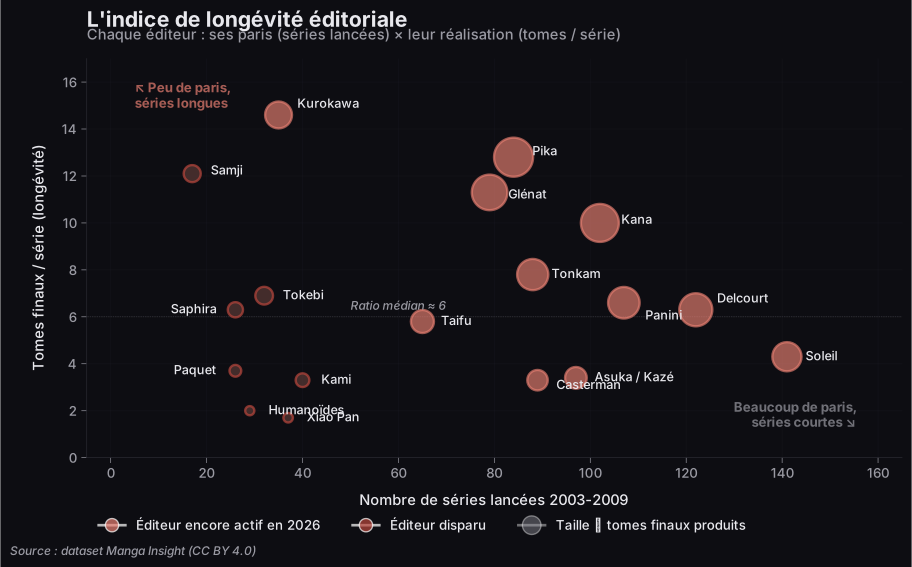
| Publisher | Series launched | Final volumes | Volumes / series |
|---|---|---|---|
| Pika | 84 | 1,072 | 12.8 |
| Kana | 102 | 1,015 | 10.0 |
| Glénat | 79 | 890 | 11.3 |
| Delcourt | 122 | 768 | 6.3 |
| Panini | 107 | 701 | 6.6 |
| Tonkam | 88 | 686 | 7.8 |
| Soleil | 141 | 600 | 4.3 |
| Kurokawa | 35 | 510 | 14.6 |
| Taifu | 65 | 374 | 5.8 |
| Asuka | 97 | 332 | 3.4 |
Three stories emerge.
Kurokawa
The exemplary model
35 series in five years. Ippo (133 volumes), Kenichi (61). Fewer bets, but all paying off.
Created in 2005 by Univers Poche, Kurokawa launches only 35 series in five years, a pace two to three times slower than its direct competitors. But its volumes-per-series ratio reaches 14.6, the best in the top 20.
With Ippo (133 volumes in the end) and Kenichi (61), Kurokawa demonstrates the opposite strategy to Soleil or Panini: fewer bets, but all paying off. It is the embodiment, in the decade of expansion, of the counter-model that says you can grow differently.
Pika
The silent winner
84 series total 1,072 volumes. Fairy Tail (63), Step Up Love Story (50).
Pika never had the media noise of Kana or Soleil. Yet it is the most profitable publisher of the decade. 84 series launched total 1,072 volumes. More than Kana, more than Glénat. The ratio is 12.8.
Fairy Tail (63 volumes), Step Up Love Story (50, already well under way since 2004), Get Backers (39), and a long tail of solid series: in the background, Pika builds the most consistent catalogue of the decade. That is the fresh angle of this section; no one tells Pika's story this way.
Kana
The Naruto effect over five years
From 3 series in 2003 to 25 in 2007. Detective Conan (104), Gintama (77).
Kana launches 3 series in 2003, 7 in 2004, 9 in 2005, 14 in 2006, and 25 in 2007. The doubling between 2006 and 2007 is the clearest investment signal of the decade.
Something happens at that precise moment: Kana decides to capitalise on Naruto, whose French sales reach levels until then unheard of for a manga, and expands its editorial line at an accelerated pace. The bet pays off. Detective Conan (104 volumes in the end), Gintama (77), Doraemon (45), Zipang (43): the decade leaves Kana the largest aggregate volume count (1,015 across 102 series), higher than that of all the historic competitors.
At the other end of the spectrum, Soleil shows 141 series for 600 final volumes, a ratio of 4.3. This is volume against longevity: the publisher tried a great deal and kept little. Asuka (3.4) and Casterman (3.3) are on the same slope. No value judgement here: these are two different editorial strategies, whose profitability depended on each house's business model. Soleil had its own logic. Pika had its own. Both survived.
The graveyard of the decade
Not every house was so lucky.
On 20 July 2003, the publisher Tokebi, the manhwa imprint of the French group SEEBD, floods French bookshops with ten simultaneous releases. Five years later, almost to the day, Tokebi disappears along with its parent company. Saphira, SEEBD's other Korean imprint, dies the same month. September 2008: René Park, the group's former head of Korean imprints, founds Samji to take over and finish the orphaned series. 2011-2012: Samji closes in turn, out of breath.
Three publishers, a single story, six years. It is the decade's central narrative for anyone interested in what disappeared. But it is not the only one. Our dataset, supplemented by the specialist archives, lets us document six cases of editorial disappearance over the decade, each with its own typology and its own distinct data signature.
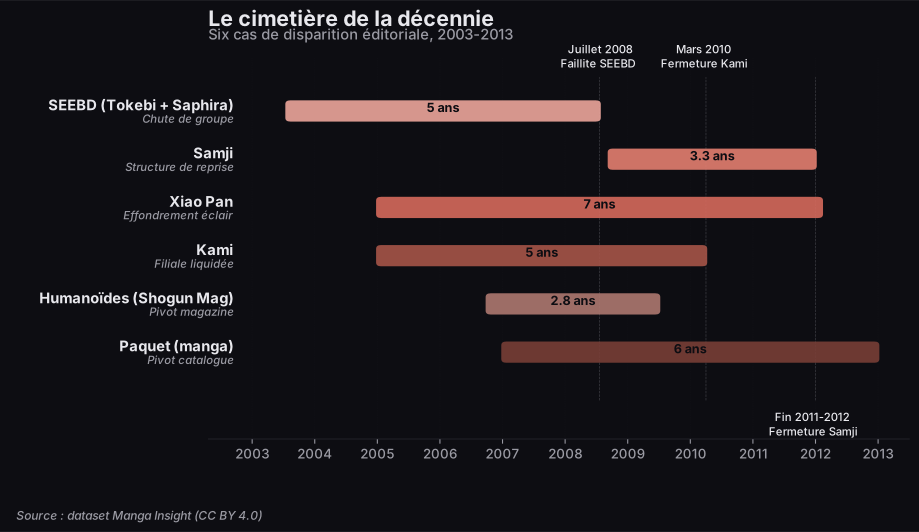
SEEBD
Tokebi + Saphira, July 2008
58 series launched between 2003 and 2007, 384 volumes in the end. Respectable ratios (6.9 and 6.3). Killed by the bankruptcy of their holding company, not by their sales.
Group collapseSamji
René Park, September 2008
Created to finish the orphaned SEEBD series. 205 volumes in the end, a misleading 12.1 ratio: it measures inherited longevity, not produced longevity. Mission accomplished late 2011.
Continuation structureXiao Pan
Ceased January 2012
37 series launched, 63 volumes in the end. Almost all stop at volume 1 or 2. Chinese manhua did not find its audience on the Japanese promise.
Flash collapseKami
Tournon group, March 2010
A very eclectic catalogue (manga, manhwa, European originals). Wound up not by market failure but by a shareholder decision tied to the parent group's troubles.
Liquidated subsidiaryHumanoïdes Associés
Shogun Mag, 2006-2009
A monthly pre-publication magazine meant to bring out a European manga. 29 series (ratio 2.0). Print stopped February 2008, online until mid-2009. Back to SF/comics.
Magazine pivotPaquet
Catalogue extinct, 2007-2013
A long-standing comics publisher (1996). 26 manga series launched, at most 33 volumes for one of them. Gradual discontinuations from July 2010, the Bao imprint stopped in 2013. Catalogue extinct.
Catalogue pivotThe group collapse: Tokebi and Saphira
SEEBD's two Korean imprints show ratios higher than those of Soleil or Asuka: these are not the numbers of editorial failure. The July 2008 bankruptcy comes from the parent company, not the catalogue. It is a financial failure, not a market failure — a decisive distinction for understanding what played out.
They were not killed by their series. They were killed by their holding company.
The French ecosystem of Korean manhwa will not recover. The publishers that try Korean manga again in the following years (Clair de Lune, Booken) will never regain Tokebi's publishing pace.
The continuation structure: Samji
Samji is not a high-performing publisher in the classic sense: it is an end-of-cycle structure, created for a single purpose: to finish the SEEBD series for the readers who had started them. The 12.1 ratio here measures inherited longevity, not produced longevity. Mission accomplished late 2011.
The flash collapse: Xiao Pan
The publisher, specialised in Chinese manhua, never managed to convert a French audience settled on the Japanese promise. Officially ceased in January 2012, after six months of radio silence. Chinese manhua will take a full decade to regain any French visibility.
Manhua will have to wait until the 2020s to regain French visibility, and it will come from a different source than the one Xiao Pan had tried.
The liquidated subsidiary: Kami
A very eclectic editorial policy: mainstream Japanese manga (Aria), Korean manhwa (Mille et une nuits), European originals (Sentai School). A subsidiary of the Tournon group, Kami is wound up in March 2010 not through market failure but through a shareholder decision tied to the group's troubles. The series in progress are abandoned midway, their readers orphaned. It is a case that reminds us that in publishing, the parent group's health weighs at least as much as the catalogue's viability.
The magazine pivot: Humanoïdes Associés
The decade's most original bet: to create a monthly pre-publication magazine devoted to European manga, in the manner of Shōnen Jump. Shogun Mag launches in October 2006, followed by three specialised sub-magazines (Shōnen, Seinen, Life). An ambitious format (240 to 340 pages), but insufficient sales and printing costs that weigh on the collected volumes.
The print magazines stop in February 2008, publication continues online until mid-2009 on Global-manga, then the site is closed. Les Humanoïdes refocus on European comics and science fiction. The bet on European manga through pre-publication did not survive.
The catalogue pivot: Paquet
A Swiss comics publisher founded in 1996, Paquet built a small, eclectic manga line without a dedicated structure comparable to Shogun Mag. The longest title in the Paquet catalogue is Usagi Yojimbo (33 volumes), which deserves its own note, below.
The decline comes through gradual attrition rather than a clear-cut decision. July 2010: first titles pulled from sale. November 2013: the Bao imprint sees several of its titles withdrawn as well. In 2026, Paquet's manga catalogue is fully halted, while the house remains active in Franco-Belgian comics and aviation.
The manga pivot took longer to die than Les Humanoïdes', but was just as unfruitful.
Sidebar: Usagi Yojimbo, the "manga" that wasn't one. Paquet's manga effort paradoxically peaks with Usagi Yojimbo, by Stan Sakai. Thirty-three volumes in the end, the publisher's biggest score. Except that Usagi Yojimbo is not a manga: it is an American comic featuring an anthropomorphic samurai, originally published by Fantagraphics. A telling symptom: in 2003-2009, the line between manga, manhwa, manhua and Japanese-styled comics was not watertight, and French comics publishers played on it. The "manga" label sometimes served more as marketing than as a taxonomic criterion.
The founding series
Beyond the publishers, there are the works. Which series launched between 2003 and 2009 had the longest trajectory?
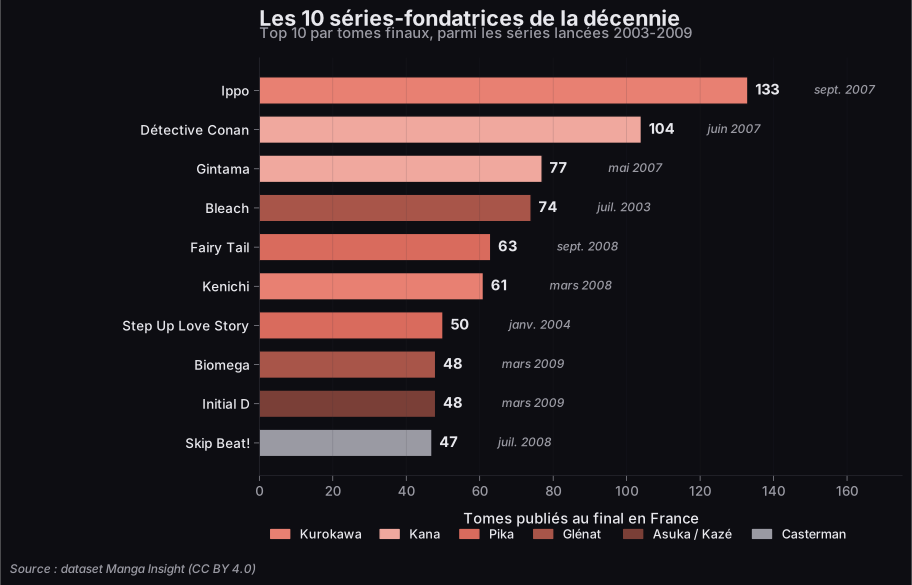
The series that will survive longest after their decade-era launch cluster around 2007-2008. This is no accident: it is the market's plateau, the moment when publishers invest in what can last. Kurokawa launches Ippo and Kenichi one after another. Kana bets on Detective Conan (despite its age in Japan) and Gintama in the same year. Pika releases Fairy Tail and confirms Step Up Love Story, already well under way since 2004. Apart: Bleach, launched at Glénat back in July 2003, four years before the plateau, but which shows that the decade could produce workhorses at any moment. It is the backbone catalogue of contemporary French manga that takes shape here.
Note. Naruto (launched in France in March 2002) and One Piece (November 2000) do not appear in this ranking because they precede our window of analysis. They remain the two structuring founding series of the decade that follows: without them, Kana's 2006-2007 investment would not have happened.
This ranking is, clearly, heavily shōnen-skewed. That is a limitation: it ranks by longevity, and long series are structurally long-running shōnen or seinen. Off to the side, several shorter works marked the decade: Death Note (13 volumes, Kana 2007), Banana Fish (19 volumes, Panini 2003), Taniguchi's A Distant Neighborhood (2 volumes, Casterman 2006). An exhaustive survey of the decade's cultural legacy is beyond this article, but it could exist.
The data signature of the bubble
Three numerical markers sum up what happened over these seven years.
The elasticity of editorial diversity. Ten publishers publish manga in France in 2000. Fifty-eight in 2008. The curve is practically linear between 2003 and 2008: three to six new entrants a year, every year, without pause. It is the signature of a market in continuous opening, where the barrier to entry stays sufficiently low to attract new players even as the market grows.
The S-curve of concentration. The top-5 ratio (the market share of the five largest publishers) follows a textbook trajectory: 80% in 2000, 49% in 2002, a low of 33.9% in 2006, then a moderate rebound to 38% in 2009. The inverted-U shape is the classic profile of a market that industrialises then reconcentrates slightly when the leaders consolidate their position. Every industrial cultural market passes through this phase.
The editorial longevity index. The final-volumes / series-launched ratio reveals three strata:
- Quality long-runners (≥10 volumes/series): Kurokawa (14.6), Pika (12.8), Glénat (11.3), Kana (10.0)
- Short volume (5-8 volumes/series): Tonkam, Taifu, Delcourt, Panini, Tokebi
- Attempts with no follow-up (<4 volumes/series): Soleil (4.3), Asuka (3.4), Casterman (3.3), Kami (3.3), Humanoïdes (2.0), Xiao Pan (1.7)
It is this third stratum that really characterises the bubble decade: a market where you could try, launch ten series to see whether one would work, and accept abandoning eight. This tolerance for editorial risk will no longer exist from 2012. The 2010-2019 decade review will show it.
What the decade bequeathed to 2010
With fifteen years' hindsight, three structural legacies of 2003-2009 emerge.
The editorial infrastructure of today's market. The publishers that make up the top 10 of the French manga market in 2026 are all arrivals or consolidations from the 2003-2009 decade: Kana, Glénat, Pika, Delcourt (with its Akata imprint until 2014), Soleil, Kurokawa, Ki-oon (created 2003), Doki Doki (created 2007 at Bamboo Édition). The decade did not only inflate the market, it manufactured its future pillars. No new entrant after 2010 reached the top 10 without first having existed during the bubble.
The first crises foretold. The 2009 slowdown foreshadows the 2010-2012 phase, which will be harsher: bankruptcies in a row, structural slowdown, rationalisation of catalogues. In hindsight, the 2003-2009 decade looks like a collective euphoria. Publishers published without restraint, readers absorbed it. That ends in 2010, and the market takes nearly ten years to return to its 2008 level.
The blind spots that will return in another form. Korean manhwa (collapsed with Tokebi and Saphira in 2008) and Chinese manhua (collapsed with Xiao Pan in 2011) are the decade's two failed bets. Both markets will return in the 2020s in another form: the Korean webtoon, then Chinese manhua in print editions carried by young specialist publishers. But that is another story. A decade's gap will have been enough to reshuffle the deck.
Only one publisher from the 2003-2009 long tail deserves mention as a positive exception: Black Box Editions, launched 2007 (4 series in our data, ratio 8.0). In 2026, it is one of the rare survivors of the decade's editorial periphery, having become a specialist in anime/manga heritage (Go Nagai, works from the 1970s-80s), often crowdfunded. It is perhaps the alternative model of the durable long tail: the one that could have saved other houses had it been identified earlier.
Methodology and limits
This review rests on the Manga Insight open-data dataset (CC BY 4.0 licence), aggregated from Manga-News' monthly schedules. The main analysis covers the 2,074 series launched between January 2000 and December 2009 (1,594 with their final volume count recorded, or 99.5% of the scope). The 2000-2002 period is treated as narrative preamble only, its coverage by our source being more fragile (112 releases recorded).
Unit of count. Each row of the dataset represents one series, attributed to its primary publisher. The final number of volumes published for each series is given by the dedicated column. For co-editions in the form "Publisher A / Publisher B / Publisher C", only the first publisher listed is kept.
Editorial consolidation conventions. Asuka, Kazé Manga and Crunchyroll - Editions are treated as a single entity (the imprint changed with the successive acquisitions, but the editorial activity is continuous). Akata-Delcourt (until 2014), Doki Doki (a Bamboo Édition imprint) and other durable co-edition structures are consolidated under their historic primary publisher. The publisher Sakka (a Casterman imprint created in 2005) is not represented as a distinct entity in our source; its releases are attributed to Casterman.
Filtering special editions. Box sets and collector's editions are excluded from the analysis when the corresponding flags are filled in the dataset. Over the 2003-2009 period, these flags are not populated (a historical ingestion limitation). A measurement on 2023-2024, where they are filled systematically, indicates that box sets and collector's editions represent 3.1% of releases on a comparable scope. The inflationary bias of the 2003-2009 count is therefore estimated below 5%: it is documented but not corrected release by release.
External corrections. For a few flagship series whose French volume count field in our source was incomplete, we verified and completed it against external sources (Wikipedia, publisher pages, ActuaBD). This is notably the case for Bleach (Glénat, launched on 17 July 2003, completed in September 2017 at 74 volumes), a series that appeared in our data with an erroneous counter. This remains an exceptional step, limited to series whose longevity is publicly documented.
Derived metric: the editorial longevity index. Ratio of (the sum of final volumes of the series a publisher launched over the period) / (the number of series that publisher launched over the period). It measures the relationship between editorial ambition (bets taken) and their fulfilment (volumes actually published to completion). A high ratio signals a long-series strategy; a low ratio, a short-bet strategy with a high abandonment rate.
Acknowledged limits. This analysis rests on a single source and has not been systematically cross-checked against external sources (ACBD, BnF legal deposits, publisher press releases). For the defunct publishers mentioned in section 4, the dates and circumstances of their cessation of activity were verified against the specialist archives (ActuaBD, du9, Manga-News); the catalogue figures come from the dataset.